Money & Taxes
How Much to Set Aside for Taxes?
How much to set aside for taxes depends on your profit, filing status and state. Plan for self-employment tax, about 14.1% of net profit (15.3% of 92.35%; the 12.4% Social Security part stops at the annual limit), plus federal income tax. The calculator below turns your expected income into a yearly, monthly and per-invoice amount.
Source: IRS Topic 554; IRS estimated taxes
No login, no account: everything runs in your browser and nothing is uploaded.
Tidied result
2026 tax year estimates, not tax advice. Consult a tax professional.
Figures checked 2026-10-16 against SSA and IRS sources: SSA 2027 fact sheet, SSA wage-base table, IRS Rev. Proc. 2025-32 (2026 brackets and standard deduction).
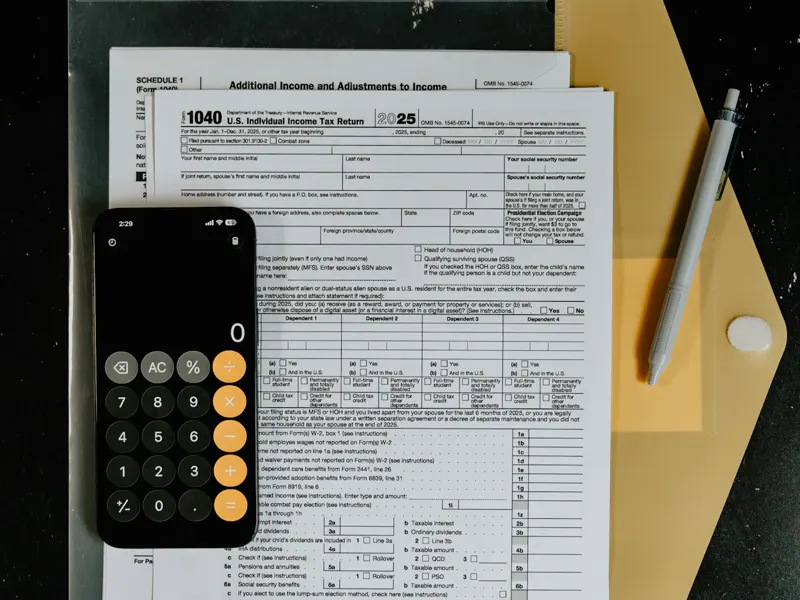
How much should I set aside for taxes on 1099 income?
The common rule of thumb for freelancers and independent contractors is to set aside 25% to 30% of net 1099 income for taxes. That range works reasonably well for a mid-income single filer with no major deductions and no state income tax, because it roughly covers self-employment tax (Social Security and Medicare, about 15.3% of most of your net profit) plus a moderate federal income tax bite. It's a rule of thumb rather than a calculation, and it can be meaningfully wrong in either direction.
The 25% to 30% estimate undershoots in a few situations: if you live in a state with meaningful income tax (add another 3% to 9% depending on where you live), if you also have W-2 income that stacks on top of your 1099 income and pushes you into a higher federal bracket, or if you have few deductions to offset your net profit. It overshoots when your net profit is fairly low, because federal income tax is progressive: a smaller net profit is taxed at lower marginal rates, and after the standard deduction a chunk of it may not be taxed at the federal level at all, leaving self-employment tax as the dominant cost. A real calculation using your actual expected profit, filing status, and state gives a far more reliable number than a flat percentage.
Do I need to pay quarterly estimated taxes?
If you expect to owe $1,000 or more in tax for the year after withholding and credits, the IRS generally expects you to pay estimated tax in quarterly installments rather than all at once at filing time. For the 2026 tax year, the estimated due dates are April 15, 2026, June 15, 2026, September 15, 2026, and January 15, 2027 (the payment covering the last quarter of the year). Missing these is more than a cash flow inconvenience: the IRS can charge an underpayment penalty calculated roughly like interest on the shortfall for each period you were behind.
The safe-harbor rule gives you a target that avoids the penalty even if your final tax bill is higher than expected: pay in, across the year, the lesser of 90% of your current-year tax liability or 100% of your prior-year tax liability. If your prior-year adjusted gross income was over $150,000 (or $75,000 if you're married filing separately), the prior-year threshold rises to 110% instead of 100%. Hitting either safe-harbor number protects you from the underpayment penalty, even if it turns out to be less than your actual final tax; you just settle the difference when you file.
What percentage for an LLC?
Forming a default single-member LLC doesn't change your tax percentage at all. For federal tax purposes, a single-member LLC that hasn't made any special election is a "disregarded entity": the IRS taxes it exactly the same as a sole proprietorship, so your business income flows straight onto your personal return and is subject to the same self-employment tax rules as any other 1099 income. The LLC changes your legal liability protection. It doesn't change your tax math, so the same set-aside percentage from this calculator applies whether you're an LLC or not.
Where things do change is if you elect S-corp tax treatment for your LLC. Under an S-corp election, you become an employee of your own business: you pay yourself a salary, which is subject to payroll tax, and take the remaining profit as a distribution, which isn't subject to self-employment tax. That can lower your overall tax bill once profits are high enough to justify the added payroll and accounting complexity. This is a materially different calculation from the one this tool runs. It's outside the scope of this calculator, but worth discussing with a tax professional if your profit is substantial.
What if I also have a W-2 job?
Income from a W-2 job is already taxed through your employer's payroll withholding, so you don't need to set anything aside for that income specifically. But it still matters for your 1099 tax planning: federal income tax brackets are based on your total taxable income for the year, so your W-2 wages and your 1099 net profit are added together (stacked) when figuring out which marginal brackets your 1099 income actually falls into. Depending on how much your W-2 job already pays, even a modest side income from freelancing can be taxed at a noticeably higher marginal federal rate than it would be if it were your only income.
This calculator's optional W-2 income field accounts for that stacking effect directly. Enter your expected W-2 wages, and the federal income tax portion of your set-aside estimate will reflect the higher bracket your 1099 profit is actually taxed at, rather than assuming it's your only source of income.
If you're a freelancer in the EU or Lithuania, see the tax dashboard instead: this page is US-specific.
How much should I set aside for taxes on 1099 income?
The common rule of thumb is 25% to 30% of net profit, but it can undershoot if you have significant state tax or W-2 income stacking, and it can overshoot at low income levels where the standard deduction and progressive brackets keep your federal tax bill small. Use the calculator above for a number based on your actual profit, filing status, and state.
Do I need to pay quarterly estimated taxes?
If you expect to owe $1,000 or more for the year, yes. The 2026 due dates are April 15, 2026, June 15, 2026, September 15, 2026, and January 15, 2027. Paying the lesser of 90% of this year's tax or 100% of last year's tax (110% if your prior-year AGI was over $150,000, or $75,000 if married filing separately) protects you from the underpayment penalty.
What percentage for an LLC?
A default single-member LLC is a disregarded entity taxed exactly like a sole proprietor: the same self-employment tax rules apply, so forming an LLC doesn't change your set-aside percentage. An S-corp election changes the calculation by splitting income into salary and distribution, but that's a separate decision from basic LLC formation.
What if I also have a W-2 job?
Your W-2 income is already taxed via employer withholding, but it stacks with your 1099 income for federal bracket purposes, which can push your 1099 profit into a higher marginal rate. Enter your W-2 income in the optional field above so the calculator accounts for the stacking effect.