Money & Taxes
Self-Employment Tax Calculator for 1099 Income (2026 & 2027)
Self-employment tax on 1099 income is 15.3% of 92.35% of your net self-employment earnings: 12.4% for Social Security, which applies only up to an annual earnings limit, and 2.9% for Medicare. You can deduct half of it when figuring income tax. This calculator applies the 2026 and 2027 limits.
Source: IRS Topic 554; IRS self-employment tax
Tidied result
2026 tax year figures (Social Security wage base $184,500). Estimates only, not tax advice.
Figures checked 2026-10-16 against SSA and IRS sources: SSA 2027 fact sheet, SSA wage-base table, IRS Topic 554.
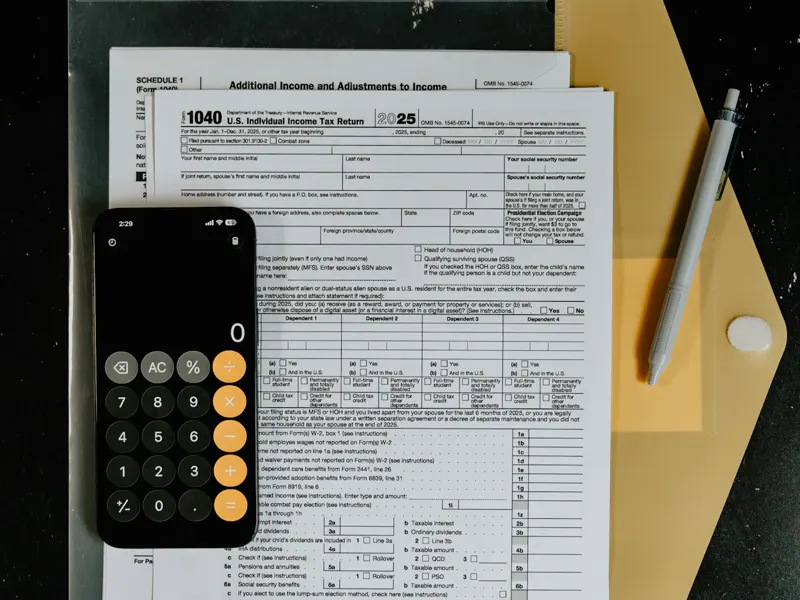
What is self-employment tax?
Self-employment tax is how freelancers, contractors, and sole proprietors pay into Social Security and Medicare, the same programs a traditional employee funds through payroll withholding. When you work for someone else, your employer pays half of these taxes and withholds the other half from your paycheck. When you're self-employed, there's no employer to split the bill, so you pay both halves yourself: a combined rate of 15.3% on your net self-employment earnings. That 15.3% breaks into two pieces: 12.4% for Social Security, which funds retirement, disability, and survivor benefits, and 2.9% for Medicare, which funds hospital insurance. It's calculated and reported on Schedule SE, separately from your regular income tax.
How is it calculated?
The calculation starts by multiplying your net self-employment profit by 92.35% to get your "net earnings from self-employment." This small discount roughly mirrors the fact that employees don't pay Social Security or Medicare tax on the employer-paid half, so self-employed people get an equivalent adjustment before the tax is applied. From there, the 12.4% Social Security portion applies only up to the annual Social Security wage base ($184,500 for 2026, $192,300 for 2027); any net earnings above that cap owe no further Social Security tax. The 2.9% Medicare portion has no cap, so it applies to all net earnings. And if your net earnings from self-employment exceed $200,000, an additional 0.9% Medicare tax kicks in on the amount above that threshold.
Worked example: on $100,000 of net profit with no W-2 wages, net earnings from self-employment are $100,000 × 92.35% = $92,350. Social Security tax is $92,350 × 12.4% = $11,451.40. Medicare tax is $92,350 × 2.9% = $2,678.15. Net earnings are well under the $200,000 additional-Medicare threshold, so that portion is $0. Total self-employment tax: $14,129.55, an effective rate of about 14.13% on the original $100,000 profit.
Can I deduct half of it?
Yes. The IRS lets you deduct half of your total self-employment tax as an adjustment to income when calculating your income tax. This mirrors the deduction an employer would otherwise get for the "employer half" of payroll taxes it pays on your behalf. You don't need to itemize to claim it; it's taken directly on your income tax return and reduces your adjusted gross income, though it doesn't reduce the self-employment tax itself. In the example above, that's a $7,064.78 deduction against income tax.
Do I pay it on top of income tax?
Yes. Self-employment tax is separate from, and in addition to, federal (and usually state) income tax on the same profit. Many new freelancers are caught off guard because they only budget for income tax and forget the extra 15.3% layer. If you're not sure how much to set aside from each payment to cover both, see how much to set aside for taxes for a simple percentage-based rule of thumb.
Freelancing in the EU, especially Lithuania? Self-employment tax as described here is a US concept. Use the tax dashboard instead, built around individual-activity and business-certificate rules.
What is self-employment tax?
Self-employment tax is the 15.3% combined Social Security (12.4%) and Medicare (2.9%) tax that self-employed people pay instead of the split employer/employee payroll tax that traditional employees have withheld.
How is self-employment tax calculated?
Multiply net self-employment profit by 92.35% to get net earnings, then apply 12.4% Social Security (capped at the annual wage base, $184,500 for 2026 and $192,300 for 2027) and 2.9% Medicare (uncapped), plus an extra 0.9% Medicare tax on net earnings above $200,000.
Can I deduct half of my self-employment tax?
Yes. You can deduct half of your total self-employment tax as an adjustment to income on your income tax return, without itemizing. It reduces your taxable income but not the self-employment tax owed.
Do I pay self-employment tax on top of income tax?
Yes, self-employment tax is separate from and in addition to income tax on the same profit. Budget for both. See how much to set aside for taxes for a simple rule of thumb.
So how much should I actually set aside — 20%, 25%, or 30%?
Freelancers commonly set aside roughly 20 to 30 percent of net 1099 income for taxes, and 25% to 30% is the range most often quoted as a safe default. Where you land in that range depends on your total income, filing status, deductions, and state, since self-employment tax alone is 15.3% before any income tax is added on top. Run your actual profit through this calculator for the precise self-employment tax figure, then see how much to set aside for taxes for the fuller estimate including income tax.